Ask a question about your life. Get a clear answer.
This system analyzes your chart, divisional charts, timing, and focuses only on what matters to your situation.
Tue, 15 Sep 2026 • 14:26 America/New_York
Columbus, Ohio, United States
NASA JPL ephemeris
DE440
Divisional charts
16+ vargas
Ayanamsa support
4 systems
Pushya-Paksha default
Dasha systems
Vimshottari + Narayana
Live in
140+ countries
Classical reference library
22 texts
A complete suite of Jyotish calculators: birth charts, Atmakaraka, Karakamsa, Sade Sati, divisional charts, Vimshottari Dasha, panchanga, and more. Computed on NASA JPL DE440 ephemeris with Pushya-Paksha ayanamsa. Built for people seeking classical Jyotish answers to real life questions, and serious students learning to read their own chart.
Deep Analysis · Not Chat
A Focused Reading for the Question That Actually Matters
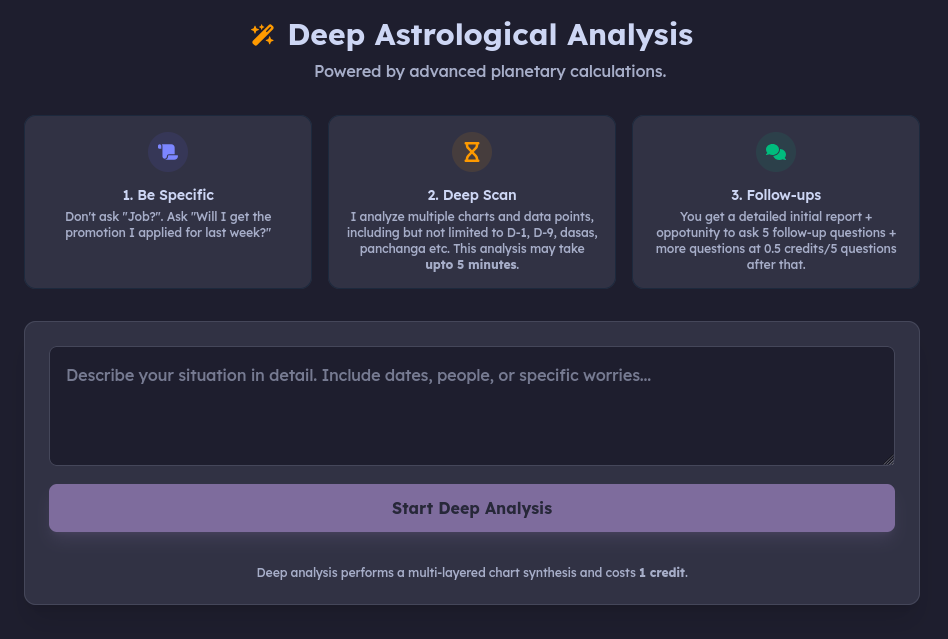
Most readings give you an interpretation. This gives you a report. Ask one specific question, a career decision, a financial concern, a crossroads, and Consult produces a structured multi-chapter analysis: your natal chart, divisional charts, annual chart, Dasha timing, transit risks, and a remedies protocol, all organized around a direct verdict on your question.
Not "here's what your chart says." Here's your answer, defended from five angles.
Remedies that are actions, not rituals
Every reading ends with something you can actually do
No generic mantras. No gemstone shopping lists. Every Consult report closes with Behavioral Remedies: specific lifestyle actions mapped to the planets and houses driving your situation.
Each remedy follows a clear formula:
[Action] → [Activates Planet] → [Strengthens House]
Repair broken household tools or infrastructure → Activates Mars → Strengthens the 4th house of Assets
Consult an elder or mentor regarding a partnership → Activates Jupiter → Strengthens the 7th house of Marriage
Delegate a leadership task to a child or junior → Activates Sun → Strengthens the 5th house of Social Status
The idea is Karma Yoga: actions that work with your chart, not against it. Every remedy targets the specific weak pillars identified in your analysis. No one-size-fits-all prescriptions.
How it works
Three steps to clarity
Our engine resolves your location, timezone, and ayanamsa automatically. Pushya-Paksha applied for sidereal precision; latitude and longitude resolved to the second.
We compute 16+ vargas including D-1 Rashi, D-9 Navamsa, D-10 Dasamsa, and D-12 Dwadasamsa, alongside Vimshottari Dasha periods (Mahadasha, Antardasha, Pratyantardasha), current transits, and Ashtakavarga points. All backed by NASA JPL DE440 ephemeris.
Personal dashboards weave transits, varga charts, and chart-specific guidance into plain language. Grounded in deterministic Jyotish calculation, not generated by a language model.
Every tool you need
Free Jyotish calculators
Vedic birth chart with planetary positions, houses, Nakshatras, and Vimshottari Dasha.
Find your soul significator and the eight Jaimini chara karakas.
The Navamsa sign holding your Atmakaraka.
Saturn's 7.5-year transit through the 12th, 1st, and 2nd from your Moon.
Find Astangata planets hidden by the Sun's glare.
Detect planets in death-like positions, with Jupiter's nullification aspect.
When the Moon transits the 8th from your natal Moon.
Find your true Vedic birthday based on Moon-Sun alignment.
Tithi, Vara, Nakshatra, Yoga, Karana for any date.
Search classical passages from the Jaimini Sutras and Phaladeepika.
Built on real data
Classical Jyotish meets modern infrastructure
Powered by NASA JPL's DE440 ephemerides through Skyfield, computing planetary longitudes with sub-arcsecond precision. Pushya-Paksha ayanamsa applied for sidereal accuracy. Every chart reflects the true celestial geometry of your exact time and place.
Forty-plus Jyotish calculators sit beneath every reading: Atmakaraka, Karakamsa, Vimshottari Dasha, divisional charts D-1 through D-60, Sade Sati, MKS, Chandrashtama, Tithi, panchanga, transits. Same birth details always produce the same chart. The language model doesn't compute the astrology; it queries the engine.
Every reading integrates your Rashi, Navamsa, and divisional charts alongside Dasha timing and current transits, so insights reflect the whole chart, not a single house in isolation. Synthesis across charts is the differentiation, not interpretation of any single one.
Interpretations anchored in classical Jyotish: Brihat Parashara Hora Shastra, Phaladeepika, Saravali, Hora Sara, and other foundational texts, curated from public-domain editions. Modern blog content and unsourced internet astrology never enter the source material.
The language model's role is to weave deterministic calculations and classical references into clear prose, not to invent the astrology. Think of it as a translator between a precision Jyotish engine and your specific question, not a black-box oracle making predictions on its own.
Every birth detail you enter is encrypted with a user-specific key before it touches our database. The key lives outside the database, so a leak can't expose your chart. Only the backend service, not our team, can momentarily decrypt to fulfill a request, keeping your insights completely under your control.
The language model is the last step, not the first. Calculations and source material come from deterministic tools and curated classical texts; the model's only job is to present them in plain language.
Frequently asked questions
What is Vedic astrology?
Vedic astrology, or Jyotish, is the classical Indian system of astrology based on the sidereal zodiac and the actual position of constellations. It uses divisional charts, planetary periods (Dashas), and a fixed reference frame to analyze life events, rather than the tropical zodiac used in Western astrology.
How is Vedic astrology different from Western astrology?
The fundamental difference is the zodiac. Western astrology uses the tropical zodiac, fixed to the seasons. Vedic astrology uses the sidereal zodiac, fixed to the actual stars — currently a roughly 24° difference in planetary positions. Vedic astrology also uses the lunar Nakshatras, sixteen-plus divisional charts, and Dasha periods, all of which are largely absent from Western practice.
What is an ayanamsa?
The ayanamsa is the angular difference between the tropical and sidereal zodiacs. Different schools use slightly different values. Lahiri is the most common modern standard. Pushya-Paksha is preferred by classical practitioners following Parashara's principles for its closer alignment with the foundational Jyotish texts.
Why does Vedic Astro Bot use Pushya-Paksha ayanamsa?
Pushya-Paksha aligns with the classical Parashara reference and produces results that match the foundational Jyotish texts more closely than the Lahiri standard. For practitioners working from classical sources, it's the more faithful choice.
What is a divisional chart?
A divisional chart, or varga, is the natal chart sub-divided to examine specific areas of life. D-9 Navamsa shows marriage and dharma, D-10 Dasamsa shows career, D-7 Saptamsa shows children, and so on. Vedic astrology uses 16+ divisional charts; Western astrology typically uses none.
What is a Dasha period?
A Dasha is a planetary period during which one planet's influence dominates events in your life. The Vimshottari Dasha, the most widely used system, divides 120 years across the nine planets, layered into Mahadasha (major), Antardasha (sub-period), and Pratyantardasha (sub-sub-period). What's running at any given time strongly shapes timing.
Are the calculators free?
Yes. All calculators — birth chart, Atmakaraka, Karakamsa, Sade Sati, divisional charts, panchanga, and others — are free with no account required. Paid features (Consult deep readings, daily personalized insights, Freeform Chat) are optional and use a credit system.
How is this different from ChatGPT astrology tools?
Most AI astrology tools pipe birth details into a prompt and let the language model invent the interpretation. Vedic Astro Bot computes everything deterministically — your chart, divisional charts, Dashas, transits, and karaka assignments are produced by purpose-built calculators, not generated by the LLM. The language model only narrates results in plain language; it doesn't decide what they are.
Ready when you are
Ask anything. Get a real answer.
Start free. Ask a question about your career, relationships, timing, or any life situation — and get a focused, chart-based answer.