Vedic Astro Bot
Soul Compass

Karakamsa Calculator

Understand where your Atmakaraka sits inside the Navamsa chart, the seat of the soul. This quick calculator highlights the spiritual directive hidden within your birth data.

The calculation runs against your encrypted birth profiles. When you are not logged in, you can still explore what Karakamsa means and why it matters.

How it works

  • 1

    Atmakaraka detected

    We locate the highest-degree planet from your natal chart.

  • 2

    Navamsa lookup

    The Atmakaraka's Navamsa sign becomes the Karakamsa.

  • 3

    Interpretation

    Receive a short briefing about the dharmic theme of that sign.

Find your Karakamsa sign

Everything runs locally until you choose to create an account.

Reuse a saved chart name or type a new label so you can find it later.

Birth date
/
/
Birth time
::
Birth place
Current selection: Not set
Birth timezone
UTC

No data is saved on server

What is Karakamsa?

The Karakamsa maps the Atmakaraka (AK) to the Navamsa (D9) chart. Analyzing this sign, its lord, and planetary influences via Rasi Drishti (sign aspects) dictates the native's innate vocational aptitudes, spiritual trajectory, and path to moksha (liberation).

Atmakaraka

The planet with the highest longitude within any sign in the Rasi (D1) chart. It represents the primary karmic binding of the soul, indicating the specific obligations and tasks the native is compelled to execute in this incarnation.

Navamsa Context

The D9 chart governs Dharma, marriage, and latent abilities. Placing the Atmakaraka in this varga grounds the soul's overarching karma into concrete skills and dictates the underlying mechanics of the native's fortune.

Karakamsa Lagna

The specific Navamsa sign occupied by the Atmakaraka operates as a functional ascendant. The 1st house from it defines innate talents, the 9th house dictates spiritual preceptors and dharma, and the 12th house (Jivanmuktamsa) identifies the Ishta Devata (guiding deity) required for spiritual liberation.

Deep Analysis · Not Chat

A Focused Reading for the Question That Actually Matters

Most readings give you an interpretation. This gives you a report. Ask one specific question, a career decision, a financial concern, a crossroads, and Consult produces a structured multi-chapter analysis: your natal chart, divisional charts, annual chart, Dasha timing, transit risks, and a remedies protocol, all organized around a direct verdict on your question.

Not "here's what your chart says." Here's your answer, defended from five angles.
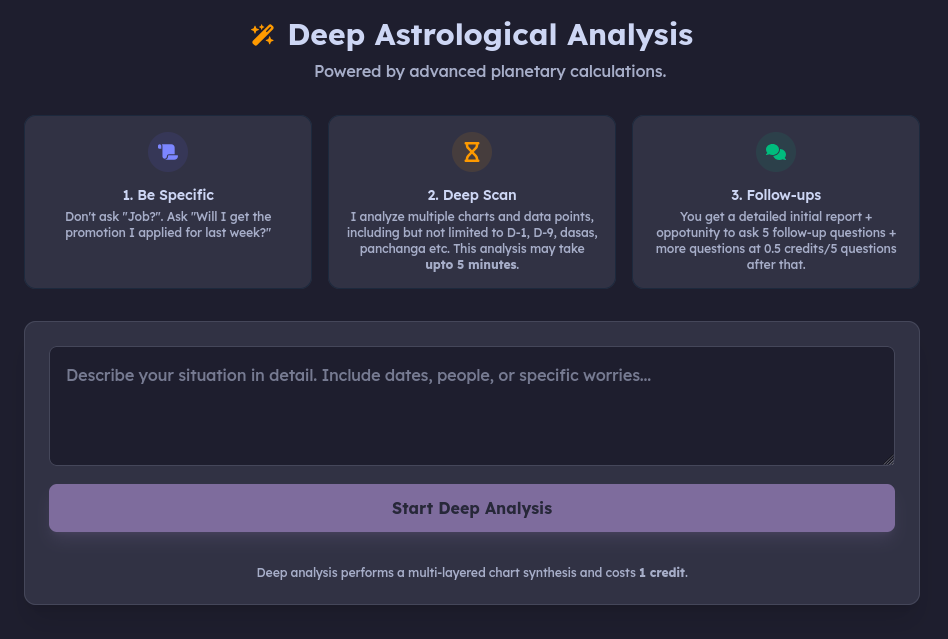
Ask a Question Feature
Each Consult runs a full multi-chart synthesis. 1 credit per reading.

Ready to see your Karakamsa come alive?

Create a free account, add your encrypted birth data, and unlock divisional charts, Ista/Dharma Devata guidance, personalized dashboards, and more.

Chart data is encrypted with your key before storing

FAQ

What is the Karakamsa Lagna?

The Karakamsa is the Navamsa (D9) sign occupied by the Atmakaraka, the planet with the highest degree in the birth chart. It reveals the soul's purpose in this life and the deity guiding the native toward liberation. Both Parasara and Jaimini treated the Karakamsa as one of the most important reference points in a horoscope.

How is the Karakamsa different from the Atmakaraka?

The Atmakaraka is a planet; the Karakamsa is a sign. The Atmakaraka planet shows the soul's key challenges and lessons in this birth. The Karakamsa sign (where that planet sits in Navamsa) indicates the soul's deeper purpose and the nature of spiritual guidance available to the native. The lord of the Karakamsa carries the same indications as the Atmakaraka itself.

What are Chara Karakas in Jaimini astrology?

Chara (temporal) Karakas are eight significators assigned based on the degrees of planets from Sun through Rahu. Unlike fixed Naisargika Karakas, they change from chart to chart. The planet with the highest degree in its sign (after dropping the sign) becomes the Atmakaraka, and the remaining planets fill the other seven roles in descending degree order. Together they form the soul's "council of ministers," showing how the native interacts with different areas of life.

What are the 8 Chara Karakas and what do they signify?

The eight Chara Karakas in descending degree order are: (1) Atmakaraka (AK) – the soul, self, the king of the chart; (2) Amatyakaraka (AmK) – advisors, ministers, career and profession; (3) Bhratrikaraka (BK) – siblings, close companions, guru; (4) Matrikaraka (MK) – mother and maternal relatives; (5) Pitrikaraka (PiK) – father and paternal relatives; (6) Putrakaraka (PK) – children and followers; (7) Gnatikaraka (GK) – kinsmen and extended relatives; (8) Darakaraka (DK) – spouse, romantic partner, also wealth and business.

Why is Rahu's degree calculated in reverse?

Rahu always moves in retrograde (reverse) motion through the zodiac. To place Rahu on the same scale as the other planets, its degree within the sign is subtracted from 30. For example, if Rahu is at 22 degrees in its sign, the effective Chara Karaka degree is 30 minus 22, which equals 8 degrees.

Why is Ketu excluded from the Chara Karaka scheme?

Ketu represents moksha (liberation), which is the ultimate goal of every soul. Since the Chara Karaka scheme describes the soul's worldly interactions and the lessons it must learn before liberation, Ketu stands outside this framework. It signifies the end of the cycle of rebirth rather than any particular role within it.

Can I use a 7-planet Karaka system instead?

Yes. This calculator defaults to the 8-planet system (including Rahu), but you can switch to either of the two 7-planet systems. The K.N. Rao school excludes Rahu and drops Pitri Karaka, while the Parasara school merges Putra Karaka with Matri Karaka and retains Pitri Karaka.

What are the different Chara Karaka schemes?

Maharshi Parasara describes 8 Chara Karakas assigned to the seven planets plus Rahu. In this system, each karaka gets its own planet. Sri K.N. Rao's school uses only seven planets (excluding Rahu), which removes the Pitri Karaka from the sequence. A third approach, also rooted in Parasara, keeps Pitri Karaka but merges Putra Karaka with Matri Karaka so that one planet governs both mother and children. The 8-karaka system is recommended by Sri Jagannath Centre and prevents the "disappearance" (Lopa) of a significator that can occur when two planets share the same longitude.